


Battery Cabinets and EV Chargers Need Fire Protection Inside the Box
November 19, 2026
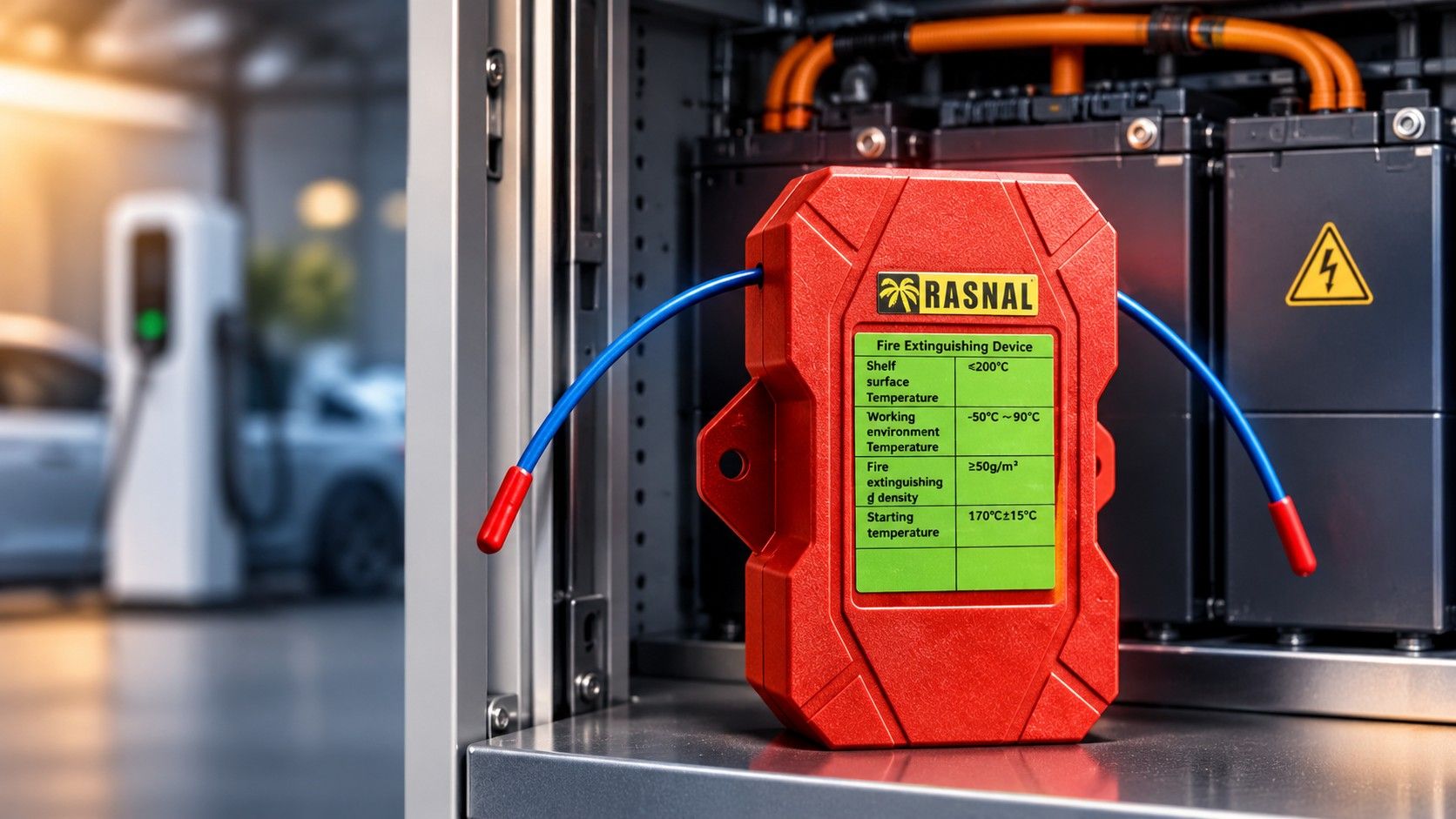
The best fire suppression for battery cabinets, inverter enclosures and EV chargers is protection that sits inside the enclosure and acts on its own. A fire in these closed boxes usually starts out of sight, often with nobody nearby. An automatic aerosol device such as Rasnal's HAFED heat aerosol fire extinguishing device mounts inside the cabinet, needs no wiring or power, and releases when heat reaches its trigger wire.
Rasnal makes two sizes. The HAFED-28 is the standard size for battery packs, EV chargers, distribution boards and industrial control cabinets. The HAFED-07 is the compact size for tight spaces such as small enclosures, MCB boxes and engine bays.
This guide covers why these enclosures carry a higher fire risk, what an in-cabinet aerosol unit can and cannot do with lithium batteries, how to size it, and how to choose between the two variants.
Why Battery and Charger Enclosures Are a Fire Risk
Battery packs, inverters and chargers pack a lot of energy and electronics into a small, closed space. That is good for design, and harder for fire safety.
- Stored energy. A battery cabinet holds energy even when the grid is off. A fault does not stop because the main switch is off.
- High current connections. Battery terminals, DC busbars and charger contactors carry heavy current. A loose or corroded joint heats up.
- Heat from power electronics. Inverters and chargers convert power all day and run warm, especially in Indian summers and in poorly ventilated rooms.
- Closed enclosures. The box protects the equipment from dust and touch, but it also hides a fire from people and from ceiling-level sprinklers or detectors.
- Unattended operation. Telecom shelters, solar plant inverter rooms, parking-level EV chargers and home battery corners are often empty at night.
These risks affect a wide group of buyers: telecom tower operators with battery banks, data centres with UPS battery rooms, factories with large backup systems, hospitals and airports with EV charging bays, commercial developers adding chargers to car parks, and homeowners going solar or hybrid with a lithium battery.
What Happens in a Lithium-Ion Battery Fire
It helps to be honest about lithium-ion batteries, because they behave differently from a simple electrical fire.
When a lithium-ion cell is damaged, overcharged or overheated, it can enter thermal runaway. The cell heats itself, releases flammable gases and can pass the heat to the cells next to it. That is why lithium battery fires can grow fast and can reignite after the flame is knocked down.
The US fire safety body NFPA addresses these hazards in NFPA 855, the standard for the installation of stationary energy storage systems. It covers topics such as fire detection and suppression, explosion control, ventilation, gas detection and thermal runaway. In other words, a good battery installation uses several layers, not a single device.
What an In-Cabinet Aerosol Unit Does Well
A heat aerosol device is one of those layers, and for the enclosure itself it is a strong one.
- It acts at the source. It sits inside the cabinet, so it responds to heat right where the fire starts, not after the room heats up.
- It needs nobody on site. Activation is automatic through a heat-sensitive triggering wire.
- It needs no power or wiring. It keeps working even when the cabinet has lost power. It fixes with industrial 3M adhesive, so there is no drilling into a battery or charger housing.
- It is safe around electronics. Rasnal states the aerosol leaves no residue on circuit boards and does not conduct electricity.
- It is low effort. Rasnal rates it maintenance free for up to 10 years.
Aerosol suppression is a recognised category. NFPA 2010 covers fixed aerosol fire-extinguishing systems in the US, and the European reference is EN 15276. Rasnal's HAFED series is certified to EN 15276-1:2019 and EN 15276-2:2019, according to its product page.
What It Does Not Do
Being clear about limits protects your people and your budget.
- It does not stop thermal runaway inside a cell. Aerosol agents work mainly by interrupting the flame. A cell that is already heating itself can keep heating and venting gas. A suppression unit buys time and limits spread inside the enclosure. It does not repair a failing battery.
- It does not replace the battery management system (BMS). The BMS that controls charging, temperature and cell balance is the first line of defence.
- It does not replace room protection. Keep fire alarms, room-level suppression where required, ventilation and portable extinguishers.
- It is single use. After it activates, replace the unit and find the cause before the cabinet goes back into service.
Used with these limits in mind, an in-cabinet unit closes the gap that room systems leave: the first minutes of a fire inside a box that nobody can see.
Where to Fit Fire Suppression in Battery and Charging Systems
Rasnal lists these spaces among the uses for HAFED units:
- Lithium-ion battery packs
- Energy storage units and inverter cabinets
- EV chargers and charging piles
- Electrical panels and distribution boards
- Telecom, CCTV and industrial control boxes
- MCB boxes and server enclosures
- Vehicle engines and small machinery
Practical placement points
- One enclosure at a time. Protect each closed cabinet separately. An open rack in a room needs room-level protection.
- Near the likely hot spots. Battery terminals, DC busbars, contactors and power modules are where faults tend to start.
- Respect the thermal clearance. Rasnal lists surface temperature limits at set distances from the unit: 75 °C or less at 0.3 m, 200 °C or less at 0.12 m and 400 °C or less at 0.05 m. Keep heat-sensitive parts and cables away from the closest zone.
- Avoid blocking airflow. Battery and charger enclosures depend on ventilation. Mount the unit where it does not block vents or fans.
- Follow the equipment maker's rules. Do not mount anything on battery modules or charger parts where the manufacturer forbids it.
How to Size It: Start With the Enclosure Volume
Rasnal lists an extinguishing density of 100 g/m³. That figure ties the amount of agent to the volume of the space it protects.
Here is a simple way to think about it. A battery cabinet measuring 0.6 m wide, 0.6 m deep and 1.0 m high has an internal volume of 0.36 m³. At 100 g/m³, that space calls for about 36 g of extinguishing agent. A larger cabinet needs more agent, which can mean a larger unit or more than one unit.
Rasnal does not publish the agent charge of each variant on its product page, so send the internal dimensions and let Rasnal confirm the variant and the number of units. Openings and vents also affect how well any aerosol holds in a space, so mention them.
HAFED-28 vs HAFED-07: Which One Fits?
Both variants share the same core specifications on Rasnal's page: operating temperature from -50 °C to +90 °C, service life up to 10 years, casing surface temperature below 200 °C and EN 15276 certification.
A simple rule: if the standard unit fits and the enclosure is cabinet sized, choose the HAFED-28. If space is tight, choose the HAFED-07. For large cabinets, ask Rasnal whether more than one unit is needed.
Matching HAFED to Common Sites
- Telecom tower and ISP shelters: battery cabinets and rectifier enclosures, often unmanned. HAFED-28 per cabinet is a typical starting point.
- Data centres and server rooms: UPS battery cabinets with HAFED-28, and compact HAFED-07 units in small server enclosures.
- Manufacturing plants: backup battery banks, drive and control cabinets.
- Hospitals and airports: UPS battery rooms, EV charging bays and critical control boxes.
- Commercial buildings and car parks: EV chargers and charging piles.
- Homes with solar or hybrid systems: inverter and lithium battery cabinets, usually in a utility room or garage where nobody watches at night.
- Shops and small offices: inverter battery corners and MCB boxes.
Reduce the Cause as Well as the Fire
Many enclosure fires start with electrical stress: loose joints, overheating and surges that slowly damage insulation and electronics. Fire suppression handles the worst case. Prevention lowers the odds of reaching it.
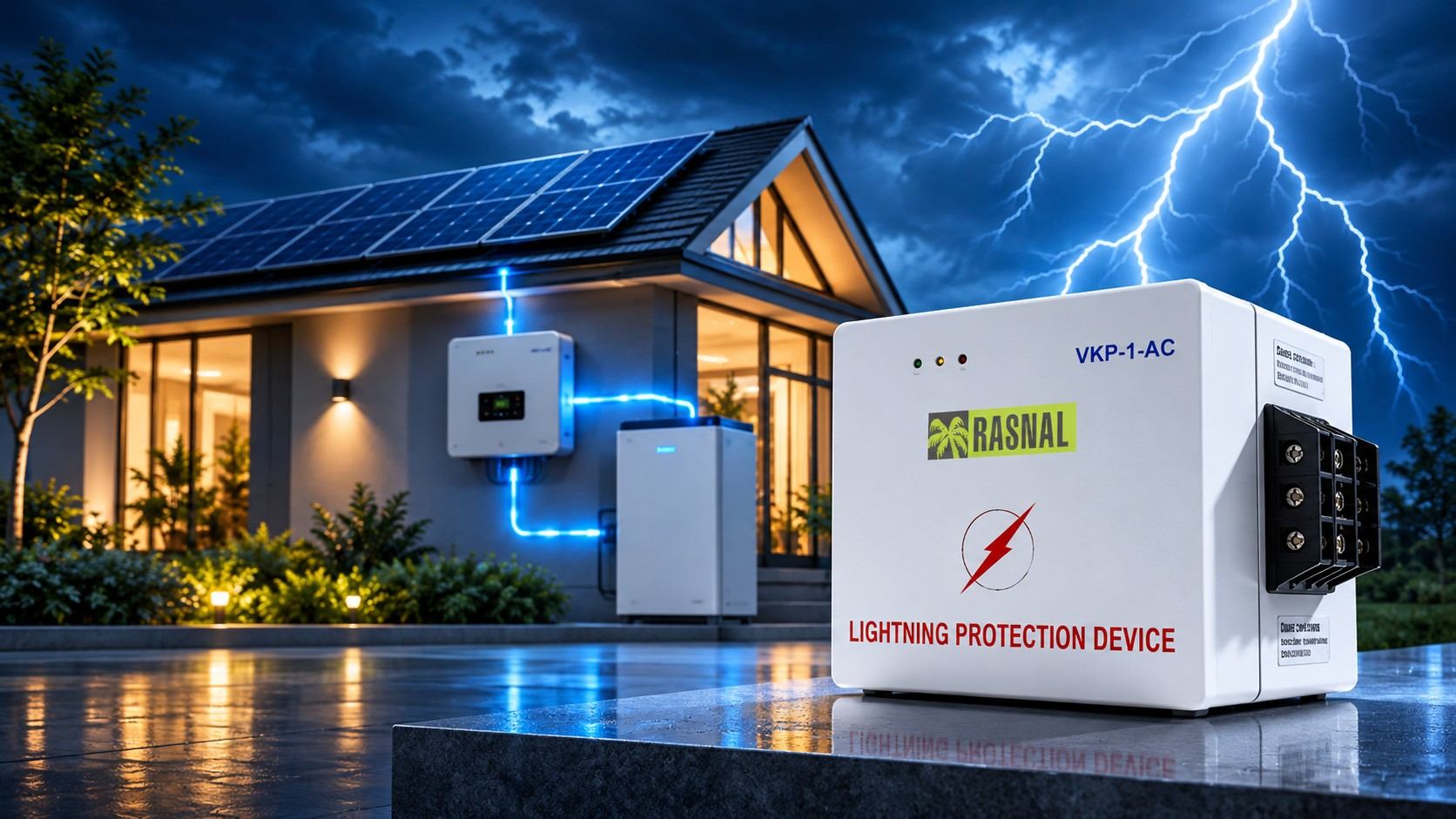
For battery and DC systems, Rasnal's VKP-01-DC digital grounding device covers 12 V, 24 V, 48 V and 110 to 175 V DC systems, including battery storage and telecom -48 V DC. On the AC side, the VKP-1-AC protects single phase boards feeding chargers and inverters. Rasnal also lists enhanced battery life among the VKP's key advantages.
How to Order
- List each enclosure: battery cabinets, inverter enclosures, chargers, MCB boxes.
- Measure the inside: width, depth and height, plus any vents or openings.
- Take photos showing the terminals, busbars and free mounting space.
- Send the details to Rasnal's team.
- Confirm the plan: HAFED-28 or HAFED-07 for each enclosure, and the number of units.
- Record the install date so each unit is replaced before the end of its service life or after any activation.
Protect the Box Nobody Is Watching
Battery cabinets and EV chargers hold energy and heat inside closed boxes, often on empty sites. A sprinkler on the ceiling or an extinguisher on the wall cannot reach a fire that starts inside them. An automatic in-cabinet aerosol unit can, and it needs no wiring or power to do it.
Pair it with a good BMS, proper ventilation and room protection, and you have a layered setup that matches how these fires actually behave. See the full details on the Rasnal HAFED page, or ask Rasnal which HAFED fits your cabinet.
Internal and External Links Used
FAQs
Q1. How do you protect a battery cabinet from fire?
Use layers: a good battery management system, proper ventilation, room fire detection, and an automatic suppression unit inside the cabinet, such as Rasnal's HAFED, that acts on its own when heat reaches it.
Q2. Can an aerosol fire extinguisher put out a lithium-ion battery fire?
It can knock down flames inside a closed enclosure and limit spread, but it cannot stop a cell that is already in thermal runaway from heating. Treat it as one layer alongside the BMS, ventilation and room protection.
Q3. What fire protection do EV chargers need?
An EV charger housing benefits from automatic in-enclosure suppression, plus site-level fire safety. Rasnal lists EV chargers and charging piles among the uses for its HAFED-28 unit.
Q4. What is the difference between HAFED-28 and HAFED-07?
The HAFED-28 is the standard size for battery packs, EV chargers, panels and control cabinets. The HAFED-07 is the compact size for MCB boxes, server enclosures, engine bays and tight spaces.
Q5. Does a HAFED unit need maintenance?
No. Rasnal rates it maintenance free with a service life of up to 10 years. Replace it after it activates or at the end of its service life.
Explore Categories

Digital Grounding devices
Industrial & Network Solutions
Solar & Smart Energy
Fire Safety Systems
Surge Protection
CCTV & Security
Solar Energy