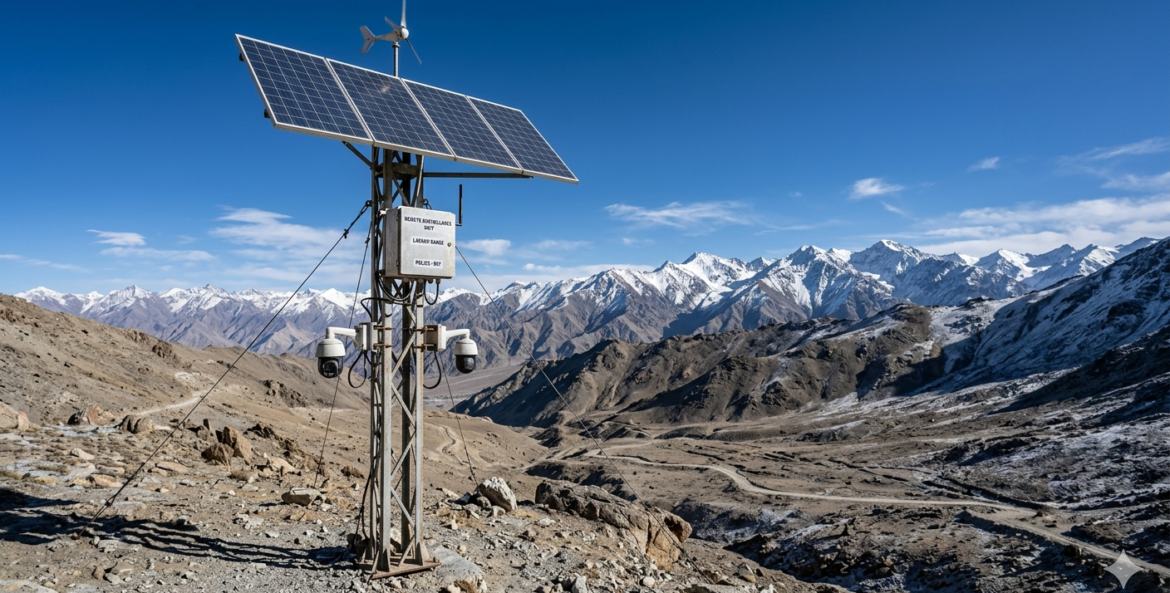
Running surveillance, communication, or networking equipment at remote locations is painful. Power cuts, expensive cabling, generator dependency, monthly fuel bills, and equipment going offline exactly when it matters most.
What if you could deploy a fully self-powered, intelligent network switch that runs 24×7 on solar energy with no grid connection, no earthing, and no external power infrastructure required?
That is exactly what a Smart Solar Network Switch does. And it is changing how forward-thinking businesses approach off-grid infrastructure across India.
“The best infrastructure is the one that just works, in the harshest environments, at the most remote locations, around the clock.”
First, let us talk about the real problem
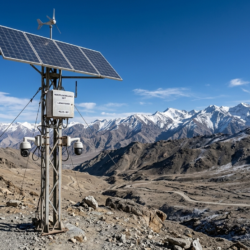
You are deploying cameras at a highway checkpoint. Or setting up a network node at a forest perimeter. Or building a surveillance system at a remote power plant. In every one of these situations, you need the same things.
- Reliable 24×7 power that does not depend on the state grid
- PoE ports to power IP cameras, PTZ cameras, and radios directly
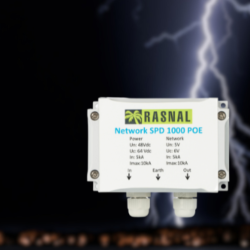
- Protection against lightning, surges, and harsh outdoor conditions
- A solution that does not need an electrician to install earthing every time
The traditional approach involves laying power cables, installing a generator, setting up earthing, hoping the diesel fuel does not run out, and hoping the monsoon does not fry your equipment. It is expensive, it is unreliable, and it is frankly outdated.
The Smart Solar Network Switch solves all of this in a single box.
Power generation, battery backup, network switching, PoE delivery, surge protection, and digital earthing are all combined into one weatherproof, pole-mountable enclosure.
So, what exactly is a Smart Solar Network Switch?
Think of it as a solar-powered brain for your remote network. It combines a managed PoE network switch with an integrated solar charge controller and battery system, all enclosed in an IP66-rated outdoor box.
It is a solar PoE network switch and a renewable energy network switch built into one device. No external power. No earthing required. You point the solar panel at the sun, connect your devices, and the system takes care of everything else.
What is inside?
| PoE Ports
4 x PoE and PoE+ (802.3af and 802.3at) |
Fiber and Uplink Ports
2 x SFP (up to 100 km) |
| Solar Input
Up to 550W at 12V DC |
Battery Support
Up to 150 to 180 Ah |
| Operating Temp
-30°C to +60°C |
Surge Protection
Up to 120 kA with no earthing needed |
| DC Outputs
12V and 48V DC for external devices |
Enclosure
IP66 rated, dust and waterproof |
Where does it actually get deployed?
The short answer is anywhere you need network connectivity and do not have a reliable power source nearby.
| Defence border surveillance | Highway and expressway CCTV | National parks and forests |
| Solar farms and wind mills | Ports and logistics hubs | Power plants and refineries |
| Tunnel surveillance | Smart city projects | Farmhouses and rural estates |
| Pipeline monitoring |
These are not niche use cases. These are exactly the environments where most infrastructure projects struggle the most, and where the Smart Solar Network Switch consistently performs best.
Trusted by the Indian Army
Rasnal’s Smart Solar Network Switch is supplied to the Indian Army for deployment in some of the most demanding border surveillance and remote monitoring environments in the country. If it works there, it will work anywhere.
The old way versus the smart solar way
Let us lay it out plainly. Here is what most businesses do today versus what a solar powered network switch makes possible.
Traditional remote deployment
|
Smart Solar Network Switch
|
The feature that makes engineers smile: no external earthing
This is genuinely underrated. Earthing is one of the most expensive and time-consuming parts of deploying outdoor network equipment. Getting it wrong causes equipment damage. Doing it right takes time, money, and specialist expertise.
The Smart Solar Network Switch has built-in digital earthing with a maximum surge handling capacity of 120 kA. That means no ground rods, no copper strips, and no earthing contractor needed on site.
Combined with 4 kV surge protection on each individual PoE port, your connected cameras and radios are protected from end to end, from the solar input all the way to the device.
Worried about cloudy days and nights? Here is how the battery backup works
This is the most common question businesses ask before deploying an off-grid network solution, and it is a fair one.
The Smart Solar Network Switch supports up to 180 Ah of battery capacity. You can configure the backup time based on your load, which includes the number of cameras, their individual power draw, and the expected low-sunlight period at your site.
In standard configurations powering two to four PoE cameras and a radio, you are typically looking at 12 to 36 hours of battery backup depending on the Ah configuration selected. Since the solar panel keeps charging during daylight hours, continuous operation across cloudy days is completely achievable with the right battery sizing.
Customisation available:
Rasnal offers the ability to customise battery backup time, number of PoE ports, fibre port count, and even box dimensions based on your deployment needs. This is not a one-size-fits-all product. It scales to your exact project requirement.
What can you connect to it?
More than you would expect from a solar powered network switch.
- IP cameras and PoE PTZ cameras on any of the 4 PoE ports directly
- Analogue HD cameras via the 12V DC power output
- NVR and DVR units using the 12V DC supply, with small 4-channel units that can be housed inside the box itself
- 4G routers and Wi-Fi access points on 12V DC or the onboard USB port
- P2P radio links on any PoE port
- IP phones on any PoE port
- Fibre uplinks via 2 SFP ports supporting up to 100 km on single-mode fibre
- AC equipment on the premium model with a 300W AC output available on request
Smart Solar FCBC: for when you need more power variety
For deployments where you need to power a wider mix of telecom equipment such as exchanges, IP-PBX systems, gateways, and routers, the Smart Solar FCBC is the complementary solution.
It delivers 12V DC, 24V DC, 48V DC, USB, and 230V AC output from a single device, all running on solar charging with battery backup. Multiple devices with different power requirements can connect simultaneously without any conflict.
The Smart Solar FCBC is available in 2 kVA and 5 kVA models. It requires no external earthing, fits a standard 19-inch rack, and is built to handle high operating temperatures ranging from -20°C to +55°C.
If the Smart Solar Network Switch is your field connectivity node, the Smart Solar FCBC is your remote equipment room power backbone. Together, they cover virtually every remote power and connectivity scenario.
Common objections, addressed directly
What happens if there is not enough sun for a few days?
Battery backup is sized for your specific load. With up to 180 Ah of storage and Rasnal contact support, you can configure enough buffer to cover your local weather patterns. Most deployments in India are designed to handle two to three consecutive low-sunlight days without interruption.
Is this rugged enough for outdoor and military-grade deployments?
It carries an IP66 enclosure rating, operates between -30°C and +60°C, handles surges up to 120 kA, and has a mean time between failures (MTBF) of 100,000 hours. It is actively deployed with the Indian Army. That speaks for itself.
We have specific camera counts and unusual cabling requirements. Can the device be customised?
Yes. Rasnal customises the PoE port count, battery capacity, fibre port count, box dimensions, and installation method including pole mount, wall mount, or rack mount, based on your project specification.
What are the ongoing maintenance costs?
There is virtually no running cost after installation. No fuel, no grid electricity bills. Battery maintenance every few years is the primary ongoing consideration. The solar panels are rated for long-term outdoor use with IP65-rated terminal boxes.
Does installation require a specialist technician on site?
The device supports pole mount, wall mount, and table mount options with all mounting accessories included. It features both physical and mechanical locks. Installation is designed to be straightforward for a trained field team without specialist electrical expertise.
Who is this built for?
This solution is purpose-built for B2B organisations managing distributed outdoor infrastructure, particularly where grid power is unavailable, unreliable, or prohibitively expensive to extend.
If your business operates in any of the following areas, a conversation with Rasnal’s team is worth having.
- Government and defence surveillance projects
- Smart city, highway, and expressway monitoring
- Oil, gas, and utility infrastructure monitoring
- Renewable energy site surveillance at solar farms and wind farms
- Enterprise perimeter security at remote locations
- Telecom tower backhaul and rural connectivity projects
Considering a Smarter Approach for Remote Deployments
If you are planning a remote deployment or evaluating ways to reduce dependency on grid power, it is worth taking a closer look at how a Smart Solar Network Switch from Rasnal Telecom & Security can be configured for your site. Factors like location, load requirements, camera count, and expected backup time all influence the right setup, and understanding these early can help avoid overdesigning or underpowering your infrastructure.