
Modern data centres are the backbone of every digital business. From e-commerce platforms and hospital records to banking transactions and government communications everything runs on servers housed in these facilities. Yet, a surprising number of facility managers still treat earthing as a checkbox rather than a critical investment.
That’s changing fast. Here’s why.
The Rising Stakes of Data Centre Downtime
India’s data centre market is growing at a rapid pace, driven by cloud adoption, 5G rollout, and the explosion of digital services. With this growth comes a critical responsibility: protecting the sensitive hardware inside these facilities from electrical threats.
A single lightning strike. A sudden grid fluctuation. A power surge from a faulty UPS. Any of these events lasting just milliseconds can fry server motherboards, corrupt storage arrays, knock out network switches, and bring an entire operation to a halt.
The financial damage? Catastrophic. Lost transactions, corrupted data, emergency hardware replacements, and reputational damage all because the facility didn’t have a robust earthing system in place.
What Is Earthing and Why Does It Matter More Than Ever?
Earthing (also called grounding) is the process of connecting electrical equipment to the earth to safely dissipate excess voltage. In traditional installations, this was a relatively straightforward requirement. But in a modern data centre, it’s a whole different challenge.
Today’s data centres run on:
- High-density server racks drawing heavy, fluctuating loads
- Network switches and routers that are highly sensitive to voltage spikes
- UPS systems and power distribution units (PDUs) that can themselves introduce electrical noise
- Structured cabling and fibre infrastructure running parallel to power circuits
Each of these components demands a clean, stable electrical reference point. Without it, even minor voltage differentials known as “ground loops” can cause data errors, intermittent hardware failures, and accelerated component degradation.
Standard earthing rods buried in the soil simply don’t cut it anymore.
Key Reasons Data Centres Are Upgrading Their Earthing Systems
1. Protection Against Lightning and Surge Events
India experiences a high frequency of lightning strikes, particularly in the monsoon season. A direct or nearby lightning strike can generate a transient voltage spike of several thousand volts far beyond what standard surge protection can handle without a proper earthing foundation.
2. Eliminating “Dirty Power” and Electrical Noise
Data centres are complex electrical environments. Power supplies switch on and off constantly. Cooling systems cycle. Variable frequency drives in HVAC units generate harmonic distortion on the electrical network.
This “dirty power” degrades equipment performance over time and can cause random reboots, memory errors, and data corruption. A well-designed earthing system especially one that includes digital grounding technology, neutralises this electrical noise and ensures a clean power reference for all connected systems.
3. Protecting PCBs, Hard Disks, and Network Cards
The most expensive components in a data centre server CPUs, RAM, network interface cards, storage controllers operate at extremely low voltages and are extraordinarily sensitive to even minor electrical disturbances.
Facility managers who have repeatedly replaced hard disks, network cards, or entire server boards without a clear reason are often dealing with a root cause that goes undiagnosed: poor earthing. Once a proper grounding system is installed, the rate of unexplained component failures drops dramatically.
4. Future-Proofing for Increased Power Density
As server hardware becomes more powerful, power density per rack continues to rise. What was acceptable earthing for a 5kW rack is wholly insufficient for a 20kW or 30kW high-density deployment. Data centres upgrading to AI inference servers, GPU clusters, or hyperconverged infrastructure must simultaneously upgrade their grounding infrastructure to match.
The Problem with Traditional Earthing Systems
Most data centre facilities were designed with conventional copper rod or plate earthing systems. These work reasonably well under stable conditions. But they have significant limitations:
- Seasonal resistance variation: Soil moisture affects ground resistance. During India’s dry summer months, soil resistance can spike dramatically, rendering the earthing system far less effective.
- Corrosion over time: Traditional copper and galvanised steel rods corrode, increasing resistance and reducing effectiveness without any visible sign of failure.
- No active monitoring: A conventional earthing system gives no indication of whether it’s functioning correctly until something fails.
This is where advanced Digital Grounding Devices represent a significant leap forward.
Digital Grounding Devices: The Modern Standard for Data Centre Protection
At Rasnal, we have seen first-hand the difference that advanced grounding technology makes. Our proprietary VKP Digital Grounding Devices are specifically engineered to address the limitations of traditional earthing systems.
Unlike conventional earth pits, the VKP series:
- Maintains consistently low ground resistance regardless of soil moisture or seasonal variation
- Actively conditions the electrical reference for connected equipment
- Provides protection at Lightning Protection Zone 1–2 (LPZ 1-2), the zones immediately exposed to the highest surge energies
- Works in tandem with surge protection devices (SPDs) and lightning protection systems for multi-layer defence
For a data centre where every server, switch, and storage array represents a significant capital investment the VKP system offers the kind of protection that prevents the kind of losses that would otherwise force emergency procurement, unplanned downtime, and difficult conversations with clients.
A Layered Protection Approach: Earthing Is Just the Foundation
Earthing is the foundation, but a truly protected data centre requires a layered approach:
Layer 1 — Earthing System (VKP Digital Grounding Device) Provides a clean, stable ground reference and safely dissipates surge energy.
Layer 2 — Surge Protection Devices (SPDs) Devices like our IPM Multi-Layer Line Protection Unit intercept transient voltage spikes before they reach sensitive equipment.
Layer 3 — Coaxial and Data Line Surge Protectors Surge protection for signal and data lines — network ports, coaxial connections that are often overlooked but equally vulnerable.
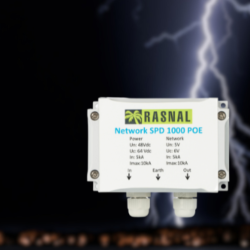
Layer 4 — RJ-45 Surge Protectors for PoE As Power-over-Ethernet deployments expand within data centres for IP cameras, VoIP phones, and access control systems protecting PoE ports from surge events becomes equally critical.
This multi-layer approach is what separates facilities that survive electrical events from those that don’t.
What Happens if You Don’t Invest in Proper Earthing?
Let’s be direct. Facilities operating without adequate earthing systems face:
- Repeated, unexplained hardware failures that drain the maintenance budget year after year
- Sudden catastrophic loss during a lightning event or grid surge, with damage running into lakhs of rupees
- Operational downtime during which revenue is lost and client SLAs are breached
- Compliance risk when audit findings reveal inadequate electrical protection
- Hidden degradation of equipment that shortens its operational lifespan, increasing total cost of ownership
The cost of prevention is a fraction of the cost of recovery.
Why Rasnal?
Since 2003, Rasnal has been protecting the critical infrastructure of some of India’s most demanding clients including the Indian Army, Navy, and Air Force, as well as enterprises like Colgate Palmolive, Chitkara University, and Theon Pharmaceuticals.
Our approach to data centre protection is never one-size-fits-all. We begin with a thorough site audit assessing existing earthing, identifying risk zones, measuring ground resistance, and mapping your equipment layout. From there, we design and deploy a customised protection solution that covers earthing, surge protection, and line protection — all backed by round-the-clock technical support.
With 3,000+ satisfied customers across North India and growing deployments PAN India, we understand the unique electrical challenges of the Indian climate and power grid.
Ready to Protect Your Data Centre?
Your servers, your network, and your business continuity deserve better than a copper rod buried in dry soil.
Contact Rasnal today for a complimentary site audit and find out exactly where your facility’s electrical protection stands and what it will take to make it bulletproof.
Frequently Asked Questions (FAQs)
Why is earthing important in a data center?
Earthing is essential in a data center because it helps protect servers, network switches, storage systems, and power infrastructure from surges, fault currents, and electrical instability. Proper grounding reduces downtime risks and supports uninterrupted operations.
How does poor grounding affect data center equipment?
Poor grounding can lead to equipment damage, unstable server performance, network interruptions, repeated hardware failures, reduced equipment lifespan, and ineffective surge protection. Over time, it can significantly increase maintenance and replacement costs.
Can earthing help reduce data center downtime?
Yes. A properly designed earthing system helps stabilize electrical performance, improves surge dissipation, reduces transient-related failures, and protects sensitive equipment ultimately lowering the risk of unexpected downtime.
What is the difference between traditional earthing and advanced earthing systems?
Traditional earthing often focuses on basic electrical safety, while advanced earthing systems are engineered for sensitive digital infrastructure. They offer better performance for modern loads, improved surge handling, and more reliable long-term protection for mission-critical equipment.
Why do surge protection devices need proper earthing?
Surge protection devices (SPDs) rely on an effective earthing system to safely divert excess electrical energy away from equipment. Without proper grounding, SPDs may not perform correctly, leaving servers and network devices vulnerable.
When should a data center upgrade its earthing system?
A data center should consider an upgrade if it experiences frequent hardware failures, unexplained reboots, network instability, surge-related damage, growing power density, or if the existing grounding system was not designed for modern IT infrastructure.
How can Rasnal help with data center protection?
Rasnal Telecom & Security provides advanced protection solutions including digital grounding devices, lightning protection, surge protection systems, and critical infrastructure support. Rasnal can assess your site, recommend the right solution, and help improve long-term uptime and equipment safety.